It’s been nearly a decade since I was on the plane, flying for endless hours between the cusp of space and the depth of the Pacific. I said goodbye to my family on the phone from the terminal at San Francisco International and stepped directly onto the plane, destined for what I largely felt was the unknown. I was headed to Shanghai, China’s largest city, a country which at that time was just on the verge of becoming known as it is today. At that time, in many Western minds, it still carried poignant residues of a shrouded past, thought of as foreign, unpredictable, and a place that, once entered, left you to the whims of communists. Even the airline assistants had to get their managers before issuing me my ticket at the counter. They told me they had never seen a one-way ticket to China, and needed to confirm I would not be detained when I landed there. Of course, that delightfully soothed my already frayed nerves for what I was about to do. I had spent a year researching and planning because once I left San Francisco, I was on my own in a land I did not understand. I could never say why I did it, but I had every inclination that a massive part of the world’s future lay in bed with an even greater part of its ancient past. Whether I was right or wrong about that didn’t matter; I was going simply because I had to go.
And off I went, with a suitcase, backpack, international calling card, a picture of a Chinese man that would meet me at the airport, and the phone number of a young Australian named Cristo. Cristo was a pen pal I made online while researching Fudan University, where I would be a student for one year. Little did I know then that I would learn from that experience for far longer than that. It was instant chemistry with the very first emails between Cristo and me, and a friendship quickly followed. When he gave me his mobile number, I was completely unaware how crucial this would be for us both after I arrived.
I landed at Pudong airport and shortly after began my search for the man in the picture I held in my hands. This quest lasted at the very least an hour, considering when I looked around, I thought, “Chinese all look the same”! Of course, that changed for me over time. The Chinese man, with the English name Jason, eventually found me. I believe seeing the same white guy with an incredibly lost look on his face, searching endlessly, gave me away. He spoke very little English, which was more than the Chinese I spoke. I remember him later telling me when we could both communicate better, “I had a hard time finding you and wasn’t sure, because white people all look the same”! He was also going by a single picture, and naturally, hearing him say that was incredibly amusing to me. We drove for about an hour through one of the most massive cities I had ever seen. Skyscrapers went on for miles, and then more miles, and the streets were swarmed with people everywhere, and I mean everywhere. They were standing by food stalls, riding bicycles in and out of the different lanes, crouched by sidewalks on their heels in a typical Chinese squat, hoards were rushing and moving in and out of traffic, and in and out of stores. It was bustling, chaotic, and alive at every turn. And on the roads, you could see everything and anything that someone could put a wheel on, this place was Barnum and Bailey’s muse. Meanwhile, we were in a black sedan that took me to the international dormitory in a district well outside the city center.
I had arrived early because I had the prudent, bright idea of getting there before classes commenced to get situated ahead of time. So when I woke up fourteen hours later, starving, in a practically empty 24-story building, I thought, now what? Driven by the most basic of human needs, I trekked down to the lobby to ask someone where I could eat, because no doubt they spoke English at the international dormitory. I would say this was the beginning of a really long drawn out, oh shit, moment. I began talking with the staff downstairs, saying I was hungry and needed to know where I could find something to eat. However, I was greeted with unexpected looks of shock and wonder, followed by a tonal noise and a new look, as if I certainly understood what they were saying. I could have made as much sense from the static of a disrupted television station. But necessity truly is the mother of invention, and by God, I needed something to eat and drink, and the water out of the tap was not an option. At that moment, I became a master of Charades and used every part of my body, and any object at my disposal, until I was understood. When my desperate message was finally received, I was given very precise directions with a single finger point. I translated it as, the food’s out there somewhere, good luck! When I walked outside, at least at the time in my particular location, every restaurant I encountered would have caused a health inspector’s pen to bleed ink. Everyone spoke only Chinese, and every menu was written in Chinese characters, naturally. Pin the tail on the donkey would have been as good a method as any for choosing a meal.
Speaking of donkeys, at that moment I realized I was probably the only thing nearby that resembled anything like a jackass. I certainly was feeling like one. So I headed back to my room to call home and give an update, then reach out to Jason or my pen pal, Cristo. The only problem was that my phone didn’t work. All backup plans built upon the accessibility of modern infrastructure were rendered useless before me, as I stared blankly at the Chinese instructions on the red phone in my hand. I remember thinking, man, I wish this red phone could reach the president, because I’m feeling a potential state of emergency coming on. Every combination dialed and tried was answered with a female cryptic message, all in Chinese. Whispering sweet nothings to me in Klingon could have had the same effect. Later, I would learn that to use this particular phone, you had to buy a calling card on the street, to buy a calling card on the street, you had to speak Chinese, then by default, to be able to follow the instructions on the calling card, you had to read Chinese. So to my and my family’s dismay, it would be well over a week before they would know that I was in China, and still with a pulse.
I took a minute and thought about my next step. I could walk right into one of those restaurants and eat something, anything, but what if I got sick? Then what if I was rushed to the nearest local hospital and given who knows what, or stuck with a dirty needle, etc. My imagination ran rampant. Ultimately, I decided to grab Cristo’s number, a handful of change, and head out to find a pay phone. Each time I left the dormitory, I could only go so far as to be sure I could retrace my steps. If I got lost, it wasn’t like I could simply ask someone, “Hey, where’s the international dormitory?” I couldn’t even hop into a cab and tell the driver to rush me to the airport. So I carefully ventured out among a sea of Chinese, foreign streets, strange smells, and awkward stares, the kind you would expect if a thousand-pound gorilla was trotting down the middle of the intersection. I dodged bicycles, mopeds, and herds of others until I finally found a pay phone. My relief at the pay phone quickly faded when I saw there wasn’t a hole to insert your change, only a slot for a calling card. It was a more modern-style pay phone relative to what may have been found on a street or a gas station in America. However, China was always like that, full of extremes and opposites, fortified and coexisting in the same place. At times, it would infatuate me, and other times, infuriate me. Just walking, you might pass an elaborate modern high rise full of luxury apartments and next to it a half-crumbling communist era building, both with residents. Maybe even pass a construction site with one man wearing a sports coat and hard hat crushing rocks with a sledgehammer, and right next to him another guy in pajamas gathering the stones. I can’t even count the times I thought, now that is such a clever idea, only to turn around in the same moment, find myself thinking, but that simply doesn’t make any sense. Unfortunately for me, this pay phone made perfect sense; only it didn’t take cents. So off I went, always with the same result. I would feel occasional surges of panic, followed by pointlessly pointed questions of, “Why did you do this?” After several hours had passed and cumulative miles walked, I sat down on a wall across from my dormitory. I looked around and it became ever more real to me that I was in a foreign land, couldn’t communicate, had no idea where I was, and couldn’t call anyone.
During this meditative review of how desperate my situation was, two Chinese women with three children approached. They were staring as they walked toward me, talking and laughing. Two children hid behind the woman’s legs, while the third came right at me with absolute curiosity and fascination. The two women sat beside me for a while and began talking to me in Chinese, and I returned the fruitless favor in English. At times, they laughed hysterically at me, and it was in that moment that I saw my situation in a completely different light. It actually was kind of funny! So I just sat there and started laughing with them. We communicated however we could, then they began removing exotic fruit from their bags to share. Staring at fruit I had never seen before, I asked if I should peel them or not. They responded by peeling the fruit for me and giving me a bottle of water. This would be one of my first and most memorable meals in China. There I was, sitting on a strange wall on the other side of the world, laughing, eating, and drinking with the kindness and curiosity of two strangers and their children.
Sometime after, I decided to check out the park behind me, which ended up being another university’s campus, and went for a stroll with a newly forged perspective. During that walk, I finally stumbled across a pay phone that would gladly accept my Chinese change. That is when I had one of those small but forever-changing epiphanies. The kind that causes you to never quite see, or assume things about, the world in the same way again. I reached into my pocket, pulled out the change, and my first thought was, “Which one is a quarter?” Then it dawned on me, perhaps they don’t even have the concept of a quarter, and I realized I was only thinking through the lens of the American system I had been raised. They may structure their currency system differently, even their concept of money may be different, perhaps the way they view the world itself is entirely different. However, after such a profound philosophical inquisition, I returned to the more immediate problem in front of me. What the hell do I put in this phone to make it work? Just as the question passed my mind, a Chinese family walked by, and I proceeded to step in front of them. There was clear shock on their faces at a white man suddenly in front of them speaking English. But I just held out my hand full of change, Cristo’s number, and pointed to the pay phone. A middle-aged man just said, “Ahhh!” Then he grabbed the change and phone number, and proceeded to make a call that could have rang the heavens. On the other end, a young man answered with an Aussie accent, “Hello, this is Cristo”! From that moment on, I would hear that voice often. Cristo would become my first and one of my best friends in China.
Unquestionably, Cristo was one of the most critical people in my life there, and at times, the closest. We talked about ideas, dreams, utter nonsense, went to clubs, threw parties, attended all the same classes, and often chilled at a little French restaurant nearby. We talked about everything all the time. But one conversation, in particular, we had at the French restaurant we attended so regularly, was about my dream of going to Tibet. I told him about when I was a kid and saw something on television about Tibet. It fascinated me instantly, from the ceremonial dress to the very noises of the horns and instruments. In my eyes, back then, I was witnessing life on another planet. It felt so far removed from where I was, like a place I would never have the possibility to see. But Tibet always hung in my mind, and I always hoped for the chance to go. Cristo looked at me after that story and said, “You’ll make it, Bryan!”, and I did! For those who might not know, getting from Shanghai to Lhasa is not exactly like catching a train to Beijing. So even though I was in China, it didn’t mean Tibet was now easily accessible. However, eventually I left Shanghai to head through Western China to Tibet. Without ever imagining it would be the last time I would ever see my friend Cristo. I would receive a call one afternoon, sitting at a restaurant on a hillside in Dali. In that call, a mutual friend would deliver a message that has left a hole in China ever since. Cristo, while sleeping next to his girlfriend one night, shuddered and took one last deep breath. The last text I would send Cristo was in the middle of the place I had seen on television as a child, “Cristo, I made it to Tibet. I’ll miss you and I wish you the best”. And I was right, because nearly a decade has passed and I still miss my friend.
I can’t say I know exactly what it was about China, but it provided an alternate reality. Time seemed to warp, and relationships were compressed and ran deeper, much quicker. I think it may have had something to do with the intensity of the environment and its effect on foreigners in our situation. You need something familiar to hold onto, and someone to rely on at times to emotionally survive, and maybe even physically survive. So the different stages you go through with love, friendships, or other relationships back home are expedited, and you grow deeply connected or apart relatively quickly. Daily intensity becomes the norm and manufactures the time machine that warps your experience. It would take years in your normal environment to encounter the absolute abundance of new and novel stimulation you can get in just one year in China. There are so many new ideas, smells, relationships, etc., continuously, all the time. People are different, your environment is different, and sometimes in some ways you’re different. When I returned from China, it felt like I had been gone for years. I also felt like the same person, but I wasn’t, and it took several years to see that emerge. How I thought, felt, reacted, and what I pursued and connected with in my life had all been altered. It still changes and impacts the course of my life today, and probably always will.
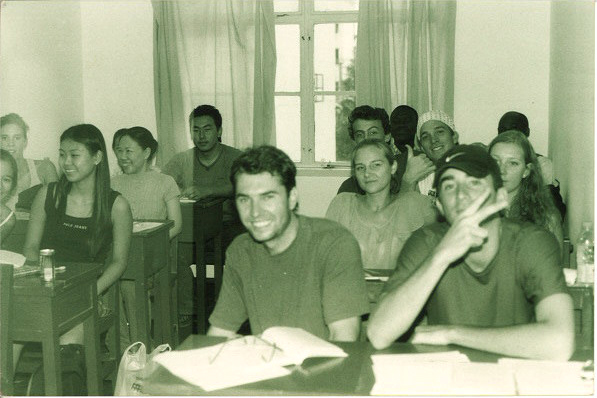
Cristo was a significant part of that experience for me, and therefore was also now a significant part of me. He signified the beginning of my life in China, while simultaneously defining its end. His death was deeply emotional and nostalgically sad. It was the end of an experience that would never leave my life the same. For some reason, when he died, my life in China began its close. I had to mourn not just the wonderful person he was, but also the memorable experience that he was such a huge part of, and begin saying goodbye to so much. Recently, I came across an old photo of my class in China. There was Cristo with his bandana on, throwing the hang loose sign, which happens to be the same sign for the number six in Chinese. Every time we would say liu (six), we’d have to say it like a stoned surfer and throw up our thumb and pinky. I miss him so often, and it stuns me how much I still feel like I should be able to pick up the phone and call him.
It’s funny that Cristo’s name should mean Christ. Because in China, in many ways, he was my savior and before my time there ended, in my mind he had died on the cross. I miss you so much Cristo and I am forever grateful.
Cristo, I made it to Tibet. I’ll miss you and I wish you the best.
 The Prodigious Pen