The best place to begin is very far away from the destination itself, in a city called Yangshuo. Littered with dramatic limestone mountains and majestic countryside, it is a truly otherworldly scene. We had spent a day rafting on bamboo rafts with a guide navigating the river with only a bamboo pole in hand. It was like a parallel universe in which you might find yourself instead exploring the canals of Venice with a Gondolier. It was the day before we would take a bus to visit the Longshen Rice terraces, also known descriptively as Dragon’s Backbone. Named so because the watered terraces along the meandering mountain ridges reflect the sun as if they were the scales along a mighty dragon’s back. It was here, crawling along the spines of legendary monsters, that we breathlessly discussed our ever-changing plans with a couple we had just met.
Taka was a Japanese man who, with his South Korean wife Mijuing, had traveled from their home in New York City to make a long-dreamed-of trip to Zhongguo (China), the middle kingdom. Within the confines of the ancient kingdom, their chance encounter with us would forever alter their trip. Exuberantly, we all discussed a rapidly evolving itinerary that now included the high plateau of Tibet. Within it, the abandoned palace of the Dalai Lama. Our paths temporarily separated, but we agreed to meet at a future date in the city of Chengdu.
Then, off to Yunnan we went, immersed in a variety of subtropical landscapes with a biodiversity as rich and varied as its people. Known to be one of the most ethnically diverse provinces within China, its cuisine was remarkably different from much of the rest of the country, and unfortunately, so was its regional bacteria. We rode out to the famous lakeside town of Dali and farther out to the ancient town of Lijiang to kiss the edge of Shangri-La. Later, after visiting The Stone Forest, a natural limestone labyrinth that would have bewildered Alice almost as much as Wonderland, our escapades in local cuisine made their ultimate invasion like a Trojan horse for Troy. The last days in Kunming would be enjoyed cuddled up and alternating between toilets and bathtubs. Revenge had made its colossal debut, transforming our bodies into tiny erupting volcanoes with flows that would draw the envy of Kilauea and Mt. Etna. It will leave you praying for God to grant any passage through such a relentless internal onslaught. One can barely fathom such a vulnerable state, where seconds turn into hours and days into eternity. However, it did end, and just in time for us to embark on the long, perilous digestive journey to Chengdu. Through hours and hours of switchbacks and mountain trails, our bus finally arrived at the port of call. Healed and ready to explore again, we traveled through vast swaths of Sichuan, ate fiery Sichuan hotpot, watched Pandas play in sanctuaries, and took a boat voyage to one of the largest sitting Buddhas in the world. Chengdu was such a lovely city with a vibe as subdued as San Francisco, and much the opposite of Beijing or Shanghai. Eventually, we reconnected with our recently met travel mates in the quintessential old town. Our primary mission was to acquire our travel visas for Tibet’s autonomous region. It was prevalent at the time to visit travel companies that set you up on a group tour to gain entry, at which point it was loosely permitted, or not strictly enforced, to arrange your travel plans once arriving at Lhasa.
Off we went on our flight with visas in hand, leaving Chengdu behind with an altitude of 1600 ft. to arrive outside Llhasa with an introductory altitude of 12,000 ft. It felt almost as if you were entering another country when you arrived at the airport. Everyone lined up to have their visas and travel documents checked and scrutinized by the authorities. Once approved, though, we were off on the bus for an hour-long ride to the capital city of Tibet.
Lhasa was like no other place I had ever been. Even after living for over a year and traveling around Southeast Asia, I could still confidently say that. From its architecture to the environment to the body language of the Tibetan people, it was all so entirely foreign. The general energy of everything feels different, and not as a foreign country would, but as another world would. This was especially prominent in the villages and towns outside of Lhasa. Lhasa, even then, had a feeling of being overrun by Chinese residents who had moved there based on incentive programs provided through the government. This created an air in many of the streets and neighborhoods that one might expect from 1800s Tombeston. In all truth and reflection, it was the Wild West of China. However, the altitude is very different than Arizona, and it was highly recommended to remain in the capital for at least 5 days to acclimate. Largely because just about any destination from there will require a climb in altitude at some point. And if you’ve ever been over 10,000 ft., the air becomes a lot thinner quite quickly with every thousand feet above that. Flying straight into 12.000 ft. already had us pulling luggage up a flight of stairs like stone pillars and, for whatever reason, having some pretty fantastical dreams throughout the first few nights.
Our first journey would be to a small village on the shores of Namtso Lake. Since it was going to be a two-day journey, I had packed several canisters of oxygen that we bought in Lhasa. It was a beautiful trip over steep, rugged mountain passes and through vast pastoral lands. One stop in a wide grassy valley, I spent roughly an hour with a random Tibetan nomad. We meandered around the field while she showed me how to use blades of grass to whistle and herd the animals. I was even fortunate enough to be invited into their yurt adorned with heavy felt curtains and softly rolled bedding. It was such an astonishingly cozy environment hidden within, far away from the ruggedness of the surrounding landscape. Afterward, feeling eternally grateful for my time spent with such a sweet nomadic herder, we were off once again to the lake. When we finally arrived, our highest priority was finding the first available public restroom. And without a doubt, it was unquestionably public! It was a large elevated rock, perched higher up a small hill, and hidden from view by another massive boulder below. As you looked down, your eyes could feast on the piles of ancestral leftovers that had no doubt been carefully cultivated over hundreds of years, and countless generations. However, the lake was beautiful and remote, with vast panoramic views over the sprawling salt waters. Looking just across the other side were the mountains that Heinrich Harrer and Peter Aufschnaiter crossed into a land forbidden to travelers, later made famous by the film “Seven Years in Tibet.”
While it was such a beautiful day that seemed endless, it finally did end with many of us feeling lightheaded, short of breath, and just overall strange. Then, relatively quickly, it progressed to more piercing headaches and general fatigue, ultimately with all of our heads hunched over, huffing on the oxygen we bought back in Lhasa. Knowing the potential environmental, political, and overall dangers an extreme environment like Tibet can pose, I spent a fair amount of time researching and planning. I learned that you don’t adapt to altitude sickness, and once it takes hold, the only solution is to decrease altitude as soon as possible. So with a limited amount of oxygen tanks, and nightfall quickly approaching, I repeatedly argued we should depart as soon as possible to drop in altitude. Because at that point, the only way to get to a lower altitude was to first go higher across the pass, which would take hours. Finally, proven victorious, I convinced my travel companions and the driver to begin the rugged road back across the mountain pass. Much of the back half of that journey was done in the dark, but we did finally safely arrive at a hotel much lower in altitude. Our symptoms started to improve almost instantaneously, and the next day, we were heading back out to the capital with a firsthand lesson on altitude sickness.
We spent a few more days hanging out at restaurants, eating momos and drinking yak butter tea, browsing local markets, getting chased by old Chinese men in the streets with their canes, and gawking at monks passing by feverishly glued to their mobile phones. Lhasa was bustling in its own right, much the way an old mining town would have been in the famous American gold rush. Naturally, we had already perused the halls and tombs of prior lamas and many of the Dalai Lamas’ historic chambers throughout the Potala Palace. Therefore, we longed for the next adventure that would take us through the vast countryside, distant glaciers, and ever more distant towns like Shigatse and Gyantse. Lands replete with ancient monasteries and revered stupas.
This leg of the trip would consist of a ten-day journey along a largely unpaved route known as the Friendship Highway, ultimately leading us to Rongbuk Monastery and Everest Base Camp. There are so many extraordinary views, cultural wonders, and exotic places that a small book could be written about them alone. However, along the voyage, two distinct moments grabbed me the most of all the rest. Especially since before my arrival, I had expected on some level to have a more enlightening spiritual experience, being enveloped in such a Buddhist Mecca. While still amazing in every right, I have to admit that I did not feel moved spiritually in even the slightest way. The only time it remotely occurred was when we stopped in a tiny village so the driver could grab some supplies, and we could take a small break ourselves from a long, rumbling journey around switchbacks and rocky roads. There were only two of us who were Western, I from the US, and another from Germany. It had been my turn to harrow in the back of the vehicle, not the most comfortable seat, and I had opened the door to stretch my legs and sit off the back. Several minutes had passed when a few young children approached me curiously to take a look. It wouldn’t be long before half the village kids had swarmed the back of the vehicle like Mick Jagger had just stepped out of a limo in Times Square. I was swarmed with them, crawling up and all around the back of the truck. At first, I was completely surprised and became a little alarmed at how much physical contact I was receiving in this munchkin mob. Then I finally realized resistance was pointless, and gave myself over to the fascination of Tibetan toddlers and curious kids. I remember thinking how dirty so many of them were, in the way that kids can be after a fun-filled day in the dirt. Adorned with ragged clothes and snotty noses, they were literally on top of me, staring directly into my blue eyes, grabbing my face, and rubbing the hair along both arms as if a genie would emerge to grant a child’s every wish. They had never seen such a specimen up close, and I was soon drunk with the enormous amount of shouting laughter and innocent child exuberance. It was as spiritual as it can get. This went on for half an hour until I was almost as dirty, exhausted, and excited as the mob itself. Finally, our Tibetan driver, equally pleased by the spectacle, scurried them off and caged the exotic white tiger from a foreign land back into the truck.
Afterward, days later, in a slightly larger village, we stumbled upon a religious landmark perched on a hill with massive prayer wheels. Tibetans had traveled from across the region to come and spin the wheels and remark prayers in a pious fashion while circling each wheel. They would walk for several paces and kneel and bow toward the direction of the prayer wheels, reciting some mantra or prayer while counting beads or holding a card of some Lama. It wasn’t so much the extraordinary scene that impacted me, but the passion and depth each Tibetan expressed with every step, every bow, and every turn of a prayer wheel. I could feel that this wasn’t just a Sunday at church; it was integrated into the very fabric of these people. Many of them lived precisely through the lens of this unique form of Buddhism. They lived it through everything they did with thoughtless ease. As if it was very much a palpable foundation on which all things are consecutively experienced. It certainly caused me to question the narrative of Chinese liberation. Well, along with the tanks and armed guards stationed at vital bridges and specific locales. I don’t mention that as a political statement, but more of a description of some momentary experience and thought. Either way, I did not feel any spiritual epiphany or guidance. But for a brief moment, I certainly was given a window into theirs, and it was almost just as moving.
Finally, many days later, we arrived at Gyatso La mountain pass, one of the highest passes in the world, just over 17,000 feet. An almost Mars-like landscape, backdropped by ridges of glaciers and snow-capped mountains, created an exotic scene of vacancy and drastic comparisons of colors. It was sunny most of the trip across the pass with barely a cloud in the sky. Having read that the weather can change dramatically within minutes, it did not disappoint. We soon found ourselves driving ever so slowly, crawling through a snowy blizzard that seemed to emerge from nowhere. It was hard to see even a few meters ahead, but after it passed almost as quickly as it appeared, it left us in a stark white landscape completely blanketed in snow.
Several hours after our tentative indulgence of an arctic tundra, we arrived at a thankfully snowless monastery that rested just a few miles from the north face base camp. When you make the journey out to base camp, it is paramount that you are very well-acclimatized to higher altitudes, because there are no quick options to get yourself to lower altitudes. I’m especially reminded of that because of a Westerner we ran into that we had met back in Lhasa. He we such an arrogant prat and we all chatted far longer than that amount of life should be afforded. Nonetheless, he was with a smaller group that was somewhat more tolerable, so we did. It wasn’t entirely uncommon to come across this personality type in Tibet. They prided themselves on being cutting-edge world types. And constantly chatted about any and all escapades in the most esoteric fashion possible. But the more common type and, certainly, a cosmic balance in the universal wheel, was authentic travelers. Their eyes were always filled with childlike wonder, trapped in permafrost. Some had been traversing the globe for years, still eewing and awing around every corner they turned. It certainly made for all types of interesting people, at least in some way, somehow, in their own right.
Well, as fortune would have it, my bugging buddy, who arrived in Tibet a week later than us, was already there outside the monastery. We sat idly watching as he was being escorted by a Chinese local. Pale-faced, arched over, and moving as if he were a drunk vagrant with the last of his change lost, the Chinese man escorted him to what could barely be described as a medic station. With his level of apparent physical condition and knowing the extent of the route back to lower ground, I often questioned how he must have fared. Hopefully, he was returned with nothing more than a bruised ego and a seemingly more humble disposition.
Our minds didn’t contend with him for too long, though. All that could be done for him now was being done. Then, soon after a couple of more cringes watching him pass out of sight, we shuffled on toward our final destination. It was a few-mile hike from the monastery to Everest Base Camp, and we had set out at different speeds. I eventually pulled out in front of the crowd, not out of competition, but with mild anxiety after seeing our dear friend from Lhasa and thinking back to our own brush with altitude sickness. With that in mind, I set out with Buddhist-level breathing and a military cadence that left me entirely lost in the march. I enjoyed the tranquil walk alone and spectated at small herds of deer along the hill ridges on either side. It went on like this for quite some time until I finally saw a raised mound, adorned with countless prayer flags, not far off in the distance. With laser-like focus, I could taste victory and embrace relief knowing I had not become the next drunken vagrant beneath the mountain. Especially considering I was currently getting aerobic at 17,000 feet. I made my final approach and rose to the top of the mound under the multitude of flapping flags and persistent whipping winds. I stood in near solitude and outright bewilderment as I looked around. I only saw two mountains in the distance, which arguably could be described more as monstrous hills. Equally confused were the only two other people there. A French couple who turned to me and asked in a stereotypical heavy French accent, “Which one is de Evewest”? My reply was simple and adorned with hints of laughter at them asking me the very same question rattling in my head. How could Everest not just be there in your face, overpowering and striking? How could we be even entertaining the question of which one is it? I just said, “Well, that one looks a little taller.” And it did! Politely, the French couple asked if I could take their picture with the taller mountain behind them. Naturally, I entertained them and took multiple shots as hard evidence that they were there. Then off they went, leaving me standing there alone, looking out and waiting for the arrival of my friends. As each friend arrived, I was greeted with all the same questions posed by the French couple. Ending with an overall sentiment of, “We did all that…for this”!
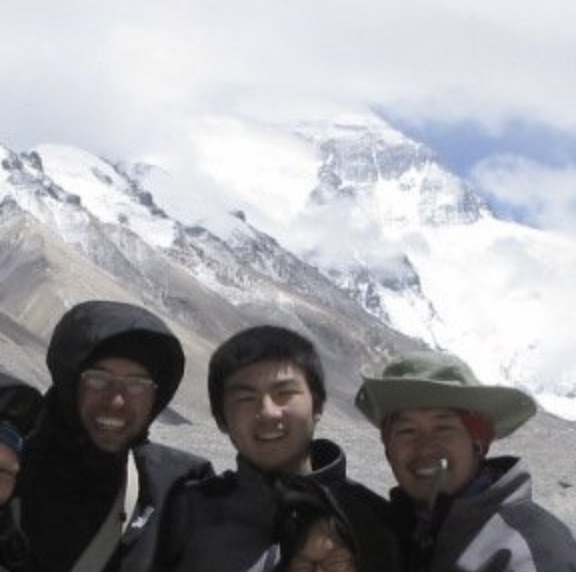
We stood there for quite some time, faintly admiring at least the accomplishment and the successful journey. Gazing out at all the tent encampments housing those biding their time until they approached the ultimate climb. Then suddenly, a glimmering light at a distance caught my eye. Bright and glowing, it expanded and grew bigger with every passing minute. I pointed toward the direction of the now rapidly spreading light and asked my friends, “What is that”? Suddenly, as if a diamond mine had been blown wide open, we saw before us a vast glimmering glacial valley. It looked as if thousands of diamonds had bejeweled the sides of the slopes. As the curtain continued to pull back, abutted right at the end of the valley, stood a colossal mountain brazenly making its Broadway debut. It was magnificent, and the peak looked entirely treacherous. Looming behind the mountain’s crown, a snow-blown contrail extended for miles. Immediately upon witnessing such a monumentally threatening sight, I knew I would never have the desire to climb it. Here, seeing it in front of me, was just simply enough.
After our journey to the top of the world, on very few occasions, I would find myself reciting my story. Every time I did, I wondered aloud about the French couple I met, captured their photo, and watched them disappear into the distance. How long did they share their journey before realizing they never actually saw Mt. Everest? As for those who did, we learned afterward that catching sight of Mt. Everest during that time of year was extremely rare. Even when it made its appearance for us, it lasted for merely a breath. However, once inhaled, its memory lasted a lifetime.
 The Prodigious Pen